Node.js 25.6.0 Release Notes: What Breaks, What Changed, What I’d Test
Another “maintenance” release. What broke this time, and why does it touch async tracking, networking headers, URL parsing, and OpenSSL?
I’ve watched teams ship patch and minor updates on Friday, then spend Saturday bisecting TLS handshakes and weird latency spikes. Node.js 25.6.0 looks useful. It also pokes several sharp edges at once, so I would not treat it as a free win.
Concerns first: the stuff the changelog won’t warn you about
This bit me before.
The release notes say a lot about new knobs, and almost nothing about the boring failure modes. If you run Node in production, those failure modes matter more than the feature bullets.
- “No known issues” does not mean “safe”: The official notes list no known issues, but that just means nobody wrote them down there. I do not trust “known issues: none” from any project, especially right after a release drops.
- Promise tracking can turn into a tax:
async_hooksinstrumentation often costs CPU and memory in promise-heavy code. Node adds atrackPromisesoption, which is great, but the notes do not give overhead numbers. You need to measure your own workload. - TOS socket controls vary by OS: Setting Type of Service sounds simple until you hit platform differences, privilege constraints, and “best effort” behavior. The release notes do not give you a support matrix in one place. Assume surprises unless you test on your exact fleet.
- OpenSSL bumps change real behavior: Even when nobody calls it a breaking change, TLS stacks change. Cipher support, defaults, and edge-case handshakes can shift. If you talk to legacy endpoints, run handshake tests before you celebrate.
- URL parser updates can change parsing outcomes: Updating the Ada URL parser to a new version can change how weird inputs normalize. If you sign URLs, compare canonical forms, or parse user-supplied URLs, you should run a corpus test.
So what actually changed in Node.js 25.6.0?
Here’s the clean list, with the parts I’d pay attention to.
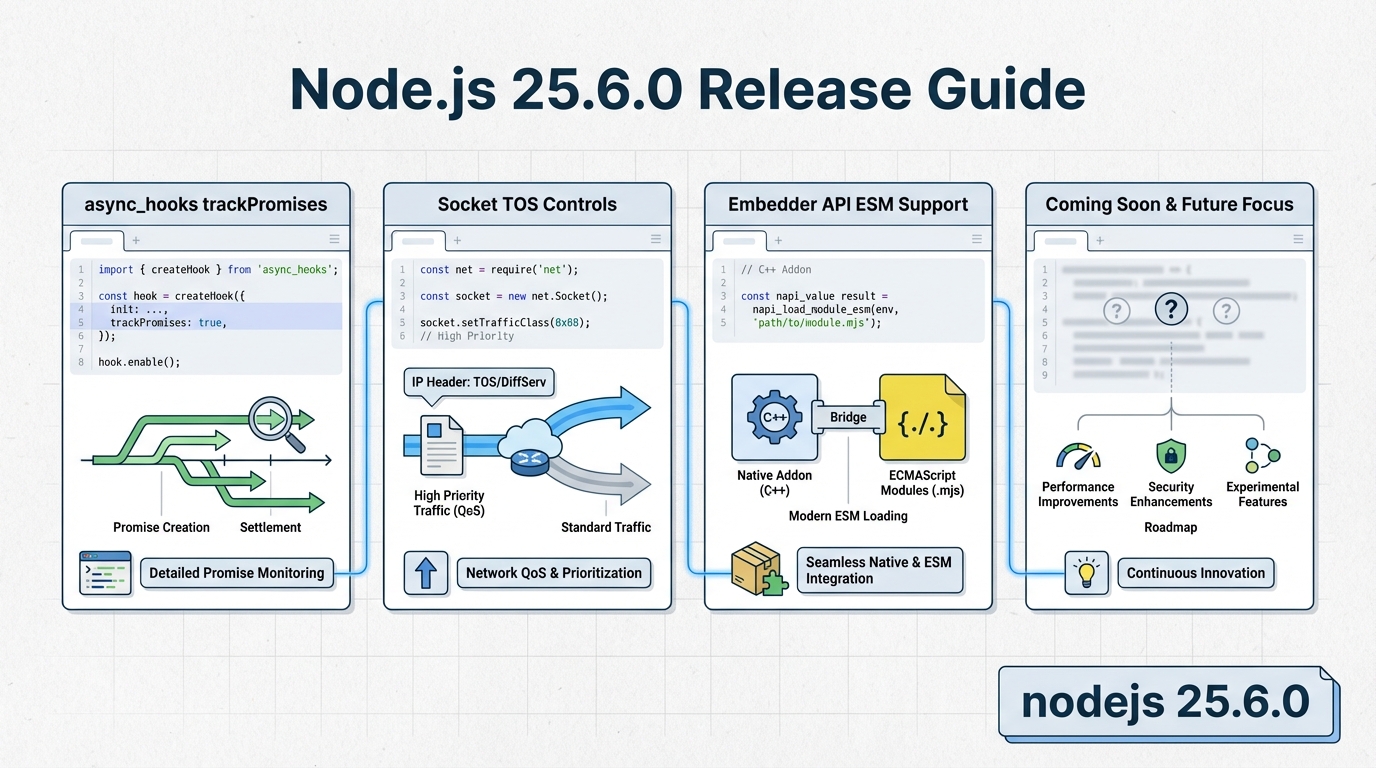
Node.js shipped v25.6.0 on Feb 3, 2026. The headline items include promise lifecycle tracking in async_hooks, a new Type of Service API on sockets, initial ESM support for embedders, and a handful of runtime and dependency updates.
- async_hooks: Promise lifecycle tracking: Node adds a
trackPromisesoption toasync_hooks.createHook()so you can observe promise creation and settlement. They claim it helps reduce overhead when you do not need promise execution tracking, but you still need to validate overhead when you enable it. - net: Type of Service on sockets: Node adds socket TOS controls via
socket.setTypeOfService(tos)andsocket.getTypeOfService(). The part to remember: this depends on the OS and network stack. Test it. Do not assume it changes packet handling in your environment. - Embedder API: initial ESM entry points: Embedders get initial support for loading ESM. “Initial” usually means “expect sharp corners,” so if you ship a custom embedder, plan time to read the PR and try it against your module loader setup.
- stream consumers: bytes():
node:stream/consumersgainsbytes()to collect stream data into aUint8Array. If your code expects aBuffer, check your call sites. - test_runner: env option:
test_runner.run()gets anenvoption for isolated test environment variables. This can fix “why did CI pass but local failed” problems, unless your tests secretly depend on inherited env state. - Performance: TextEncoder: Node improves
TextEncoder.encodeusing simdutf. Great, but measure on your CPU and container base image. SIMD paths can behave differently across architectures. - url: Ada parser update: Node updates Ada to 3.4.2 with Unicode 17 support. If you do URL-heavy work, run regression tests against real inputs, not just “happy path” URLs.
- Dependencies: undici 7.19.2, corepack 0.34.6, nghttp3 1.15.0, ngtcp2 1.20.0, and OpenSSL 3.5.5. Dependency bumps cause most of the “nothing changed” outages I’ve seen, because they change behavior outside your diff.
What I’d test in staging before I let this near production
Test this twice.
I’d wait a week for ecosystem noise, then I’d do a canary. Some folks skip canaries for minor releases. I do not, because I like sleeping.
- TLS sanity: Run a handshake suite against every external dependency that still scares you. Old proxies, legacy APIs, that one vendor endpoint that only fails in one region.
- HTTP client behavior (undici): Hit your highest-QPS routes and watch connection reuse, timeouts, and error rates. If you pin undici behavior indirectly through frameworks, this matters.
- Async hot paths: If you plan to use
trackPromises, load test with it on and off. Watch heap growth and p95 latency. If it adds 5 ms to a hot endpoint, you will feel it. - URL parsing regression corpus: Feed the new URL parser the ugliest URLs you see in logs. Compare normalized outputs if you do redirects, signing, allowlists, or cache keys.
- Network TOS verification: If you actually need TOS, capture packets and confirm the DSCP/TOS bits show up. “API exists” does not equal “network respects it.”
Do not claim “no known issues.” Say “none listed in the official notes as of today,” then keep a rollback plan.
Recommendation (grudgingly)
I’d wait.
If you need promise lifecycle visibility right now, or you have a clear use case for Type of Service tagging, try 25.6.0 in staging and canary it into one slice of traffic. If your app runs fine on 25.5.x and you are not chasing one of these features, give it 7 days, watch for issue reports, then roll it out with a quick rollback path. Other stuff in this release: dependency bumps, some parser changes, the usual. There’s probably a better way to test this, but…
Related Reading
- Node 20 vs 22 vs 24: Which LTS to Run — The version decision for production Node.js
- Node.js 20 End of Life: Migration Playbook — EOL April 30, 2026
Upgrade and verify commands
Here is the exact sequence I would run to upgrade and smoke-test Node.js 25.6.0 in a staging environment:
# Check current version
node --version  # v25.5.0 or whatever you're on

# Upgrade via nvm
nvm install 25.6.0
nvm use 25.6.0
node --version  # v25.6.0

# Quick smoke test: verify TLS still works against your APIs
node -e "
const https = require('https');
['https://api.github.com', 'https://registry.npmjs.org'].forEach(url => {
  https.get(url, {headers: {'User-Agent': 'node-test'}}, res => {
    console.log(url, '✅', res.statusCode);
  }).on('error', e => console.log(url, '❌', e.message));
});
"
Try the new trackPromises API
The trackPromises option in async_hooks is the most operationally relevant feature in this release. Here is how to use it for leak detection:
// track-promises.mjs
import { createHook } from 'node:async_hooks';

let activePromises = 0;

const hook = createHook({
  trackPromises: true,
  init(asyncId, type) {
    if (type === 'PROMISE') activePromises++;
  },
  destroy(asyncId) {
    activePromises--;
  }
});
hook.enable();

// Log active promise count every 5 seconds
setInterval(() => {
  console.log(`Active promises: ${activePromises}`);
  // If this number grows continuously, you have a promise leak
}, 5000);
Test the Type of Service socket API
// test-tos.mjs - verify TOS bits on your platform
import net from 'node:net';

const server = net.createServer(socket => {
  // Set DSCP value (Expedited Forwarding = 46, decimal = 184)
  socket.setTypeOfService(184);
  const tos = socket.getTypeOfService();
  console.log(`TOS set to ${tos} (expected: 184)`);
  socket.end('ok');
  server.close();
});

server.listen(0, () => {
  const { port } = server.address();
  const client = net.connect(port);
  client.on('data', () => client.end());
});
If getTypeOfService() returns 0 instead of 184, your OS or container runtime is stripping TOS bits. Common in Docker with default network drivers.
Official Node.js Resources
- Node.js v25.6.0 official release post – the canonical changelog with every commit, contributor credit, and notable mention.
- Node.js CHANGELOG on GitHub – the full project changelog covering every release across all active release lines.
- Node.js previous releases – release schedule, LTS timelines, and end-of-life dates for every Node.js version.
Track Node.js versions
Monitor all Node.js releases, LTS schedules, and EOL dates on our Node.js release tracker. Check your dependencies for EOL packages with the free dependency EOL scanner, and see the full Node.js support timeline on our interactive LTS timeline.
🛠️ Try These Free Tools
Paste your dependency file to check for end-of-life packages.
Plan your upgrade path with breaking change warnings and step-by-step guidance.
Get Docker base image recommendations for your requirements.
Track These Releases