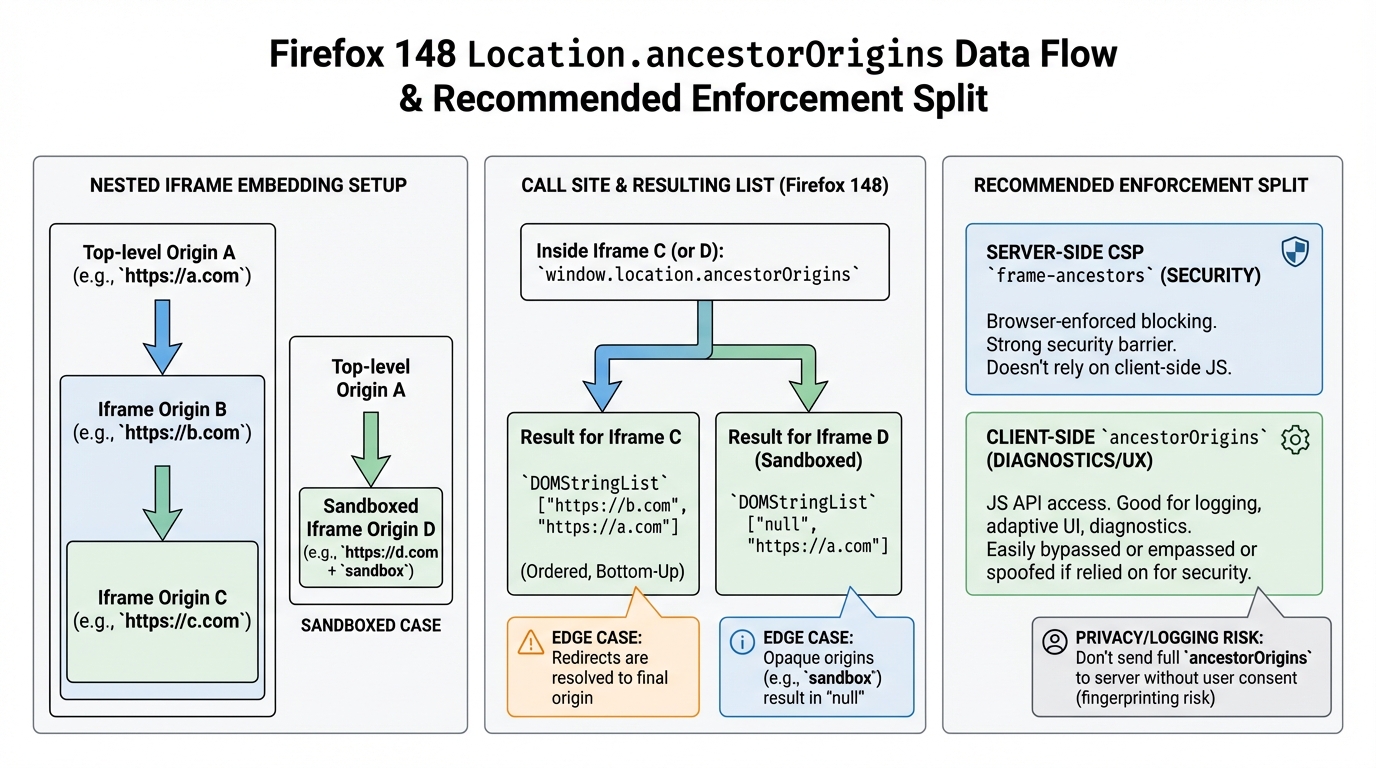
Firefox 148 adds Location.ancestorOrigins. Your iframe SSO might panic.
I’ve watched “works in Chrome” iframe logins melt down the minute Firefox starts behaving like everyone else.
Firefox 148 adds Location.ancestorOrigins, which means code that used to skip a branch in Firefox can suddenly run. If your SSO flow hides inside an iframe and relies on brittle embed checks, test this before 2026-02-24, not after your support inbox fills up.
What changed: Firefox 148 now returns an embed origin chain
This bit me once in a widget SDK that tried to “detect framing” with a pile of browser sniffing.
Firefox 148 supports location.ancestorOrigins (Bug 1085214). The browser returns an origin chain for the documents that embed the current page, which sounds harmless until you realize how much “anti-embed” code assumes Firefox never exposes that signal.
- If you branched on “missing API”: Some code does if (!location.ancestorOrigins) and treats that as “Firefox mode.” Firefox 148 flips that condition, so the “other browsers” path runs in Firefox too.
- If you enforce policy in the client: Client-side “block if framed by X” checks break in redirect-heavy auth flows and sandboxed stacks. Use CSP frame-ancestors on the server for the actual boundary.
- If you log it for debugging: Treat embedding origin chains like sensitive data. An origin chain can reveal partner sites, internal portals, or customer environments. Redact or hash if you must collect it.
Browser support timeline: Firefox was the last holdout
This API is not new. Firefox was just late to the party, and that gap shaped a decade of workarounds.
Chrome shipped location.ancestorOrigins back in 2014 (around Chrome 20). Safari followed shortly after and has supported it since Safari 6. Edge picked it up when it moved to Chromium in 2020. For years, Firefox was the only major browser that returned undefined for this property — Bug 1085214 sat open on Bugzilla for over 11 years before landing in Firefox 148.
That decade-long gap matters because developers wrote detection code around it. Libraries like older versions of postmate and hand-rolled widget SDKs used location.ancestorOrigins === undefined as a proxy for “we’re in Firefox.” That assumption is now broken, and any code path gated behind it will execute for the first time in Firefox.
The privacy discussion also delayed the implementation. Mozilla’s privacy team flagged that exposing the full ancestor chain could enable passive fingerprinting — an embedded page could learn which sites frame it without needing any cooperation from the parent. The final implementation followed the WHATWG HTML spec (PR #11560), which exposes cross-origin ancestors as opaque origins, mitigating the worst tracking concerns.
The failure mode I expect: iframe SSO deadlocks
🔔 Never Miss a Breaking Change
Get weekly release intelligence — breaking changes, security patches, and upgrade guides before they break your build.
✅ You're in! Check your inbox for confirmation.
SSO breaks loudly.
The thing nobody mentions is how often login flows “work” by accident. A widget iframe loads /login, bounces through two redirects, then runs a postMessage handshake back to the parent. If one step includes “are we embedded by an allowed parent” logic, Firefox 148 can push you into a different branch and you get a loop, a blank iframe, or a stuck spinner that never times out.
Some folks skip canaries for browser changes. I don’t, but I get it. Still, if you can’t run Firefox Beta in CI for your auth flow, you probably should not ship iframe-based auth at all.
Rule I use: keep embed policy on the server (CSP frame-ancestors). Use ancestorOrigins for diagnostics and user messaging, not enforcement.
Quick diagnostic: detect and log your ancestor chain
Drop this into any page you suspect is affected. It will print the ancestor origin chain in every browser that supports the API, and tell you when it’s missing.
// paste in your iframe's console or add to your auth entry point
if (location.ancestorOrigins && location.ancestorOrigins.length) {
  for (let i = 0; i < location.ancestorOrigins.length; i++) {
    console.log(`ancestor[${i}]:`, location.ancestorOrigins.item(i));
  }
} else if (location.ancestorOrigins) {
  console.log('ancestorOrigins exists but is empty — top-level page');
} else {
  console.log('ancestorOrigins not supported in this browser');
}
Run this in Firefox 148 Beta alongside Chrome. If your SSO flow takes a different path based on the output, you’ve found your bug before your users do.
What to test this week (not next month)
Make a tiny embed-chain page.
Don’t overthink it. Build a test page that nests 2 iframes deep and prints location.ancestorOrigins at each layer, then add one variant with a redirect in the middle. Run it in Firefox 148 Beta and your current production browser set. Fail the build if your app takes a new “blocked” path in Firefox.
- Nested iframe ordering: Verify your code doesn’t assume reverse ordering or “parent first.” If you assumed an order, write it down and assert it in a test.
- Empty or missing values: Handle “no ancestors” as a first-class case, not a fallback you never hit.
- Sandboxed frames: Add a sandbox variant. That’s where embed code goes to die in strange ways.
Red flags to watch for in prod
Firefox-only bugs feel personal.
When this breaks, it won’t always throw a clean exception. It often shows up as “login works top-level, fails embedded” or “Chrome works, Firefox returns 401 in the iframe.” Look for these symptoms and treat them like a release-blocker, not a one-off customer complaint.
- 401/403 only inside iframes: Check whether the server started enforcing embed rules differently than the client expects, especially around redirects and callback URLs.
- postMessage handshakes that never complete: Add timeouts and a visible “Open in a new tab” escape hatch for embedded login. Do not leave users staring at a spinner.
- Telemetry creep: Search logs for new fields containing ancestorOrigins or arrays of origins. Treat it as sensitive and kill it fast if you don’t need it.
Troubleshooting iframe SSO after the update
If your embedded login already broke — or you want to harden it before Firefox 148 ships — work through this list in order.
- Search your codebase for
ancestorOrigins. Grep everything: client bundles, SDK dependencies, vendored scripts. Any conditional that branches on the existence or length of this property needs review. - Replace browser sniffing with feature checks. If you find
if (!location.ancestorOrigins)used as a Firefox detector, remove it. Usenavigator.userAgent(reluctantly) or, better, eliminate the browser-specific path entirely. - Move embed enforcement server-side. Add
Content-Security-Policy: frame-ancestors 'self' https://trusted-parent.comto your login endpoint response headers. This is the canonical way to control who can frame your page — no client JS required. - Add a postMessage timeout with an escape hatch. If your iframe auth relies on a
postMessagehandshake, add a 10-second timeout that renders a “Having trouble? Open login in a new tab” link. Users should never stare at a blank iframe. - Test in Firefox Beta now. Download Firefox Beta (148), load your embedded flow, and confirm the login completes. Automate this in CI if you can — Playwright supports Firefox and can run the full iframe chain.
FAQ
Does Location.ancestorOrigins expose my parent’s full URL?
No. It exposes origins only — scheme, host, and port. You will never see paths, query parameters, or fragments. For cross-origin ancestors, the spec returns opaque origin values, so the privacy exposure is limited to same-origin ancestors.
Will this break my app if I don’t use ancestorOrigins anywhere in my code?
Probably not directly. The risk is in third-party code — analytics scripts, widget SDKs, or auth libraries that silently check for this property. Audit your dependency tree, not just your own source.
Can I polyfill or suppress ancestorOrigins in Firefox?
You can’t delete or override location.ancestorOrigins — it’s a read-only property on the Location object and the browser won’t let you redefine it. If you need to neutralize it for testing, use a Proxy-based mock in your test harness, not in production.
What about Brave and other Chromium forks?
Brave has been discussing restricting the ancestor chain (see brave/brave-browser#33671) to limit cross-site tracking. If you build logic that depends on the full chain being accurate, it may not work consistently across all Chromium-based browsers either. Yet another reason to keep this in the “diagnostics only” bucket.
Document Picture-in-Picture exists, but don’t bet your roadmap on it
Prefs mean churn.
Firefox 148 also lists Document Picture-in-Picture (Bug 1858562) behind dom.documentpip.enabled. You can prototype UI-in-PiP without the “video-only PiP” hacks, but pref-gated APIs attract edge cases like fruit flies. Ship experiments, not commitments.
Other stuff in this release: dependency bumps, some image updates, the usual. Anyway.
If you own an embedded widget or iframe login flow, treat Firefox 148 as a deadline. Test in Beta, move enforcement to CSP, and keep ancestorOrigins in the “debug tool” bucket.