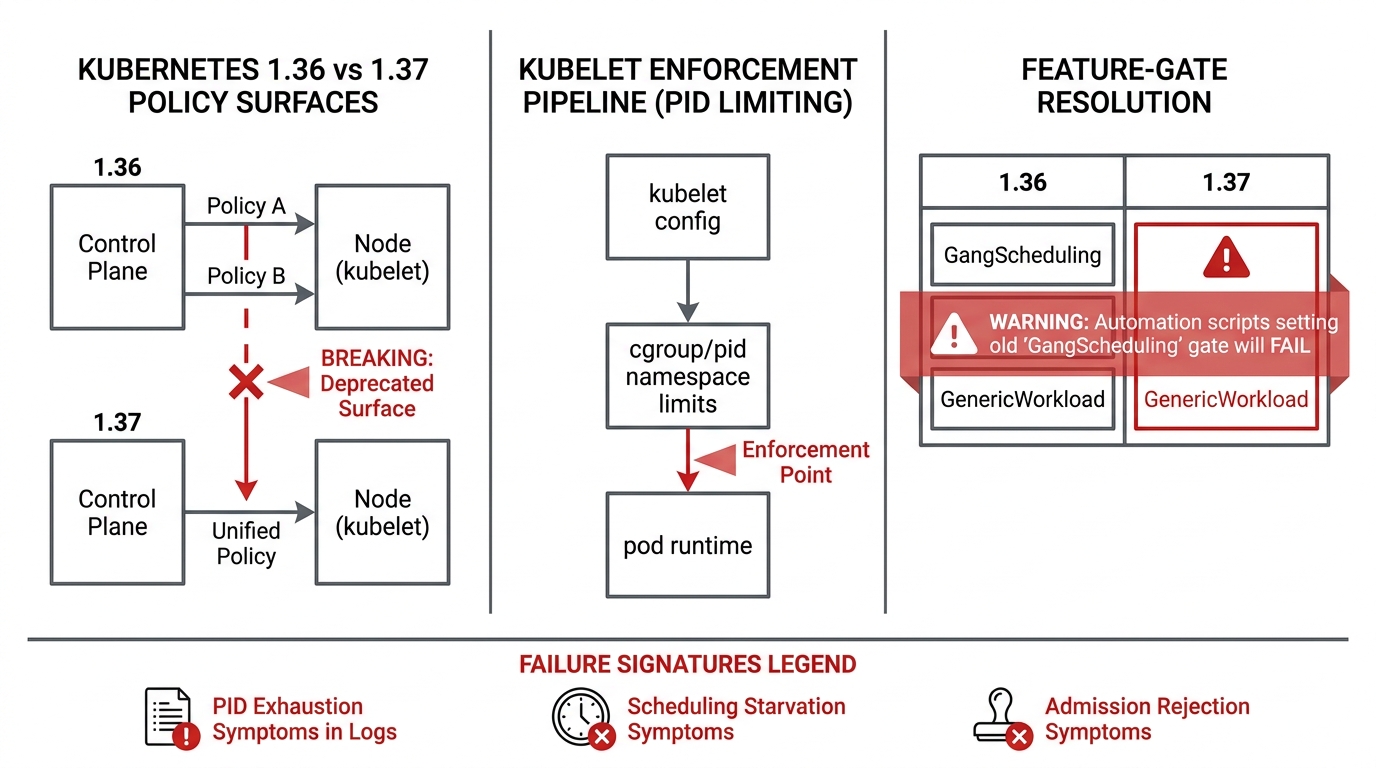
KEP-6063: Per-Pod PID Limit (alpha) — fork bombs, but make them boring
Per-pod PID limiting is the kind of feature you only care about after you’ve been burned: a runaway process tree, a broken sidecar that respawns too aggressively, or an “agent” that goes wide across a node and starves everything else. Kubernetes already documents PID limiting via kubelet configuration (–pod-max-pids / PodPidsLimit), and 1.37 is wiring more explicit per-pod semantics into the platform roadmap. ([kubernetes.dev](https://www.kubernetes.dev/resources/keps/?utm_source=openai))
So what? Expect a new class of workload failure where the pod is alive, CPU is fine, memory is fine, and yet process creation fails. Your app logs will look like a mystery unless you’re already scraping node-level signals and correlating them back to the pod. That’s operational debt you either pay now (instrumentation + alerting) or later (postmortem).
KEP-2837: Pod-Level Resource Specifications (GA target) — policy engines will lag reality
Container-only resource assumptions have been baked into tooling for years: admission controllers, internal linters, cost allocation, and “helpful” mutating webhooks that rewrite requests/limits. KEP-2837 signals that pod-scoped resource specs are heading to GA in 1.37. ([kubernetes.dev](https://www.kubernetes.dev/resources/keps/2837/?utm_source=openai))
So what? Anything that inspects or rewrites resource fields may misbehave: reject valid manifests, or worse, accept them but compute the wrong effective requests/limits. The gotcha isn’t the API; it’s the shadow ecosystem around it.
KEP-4671: Feature gates merge — “it’s enabled” doesn’t mean what it used to
KEP-4671 merges two feature gates into one in 1.37: GenericWorkload becomes the single gate, and the older split gate names stop being the source of truth. ([kubernetes.dev](https://www.kubernetes.dev/resources/keps/4671/?utm_source=openai))
So what? Your automation is probably string-matching gate names in a values.yaml somewhere. That’s not “configuration,” that’s a time bomb with a commit hash.
Kubernetes keeps drifting toward higher density and more heterogeneous workloads. The industry keeps shipping more background daemons (security agents, service mesh sidecars, observability collectors), then acts surprised when nodes behave like shared hosts again. PID limits and pod-level resource semantics are maintainers acknowledging the obvious: Linux has real ceilings, and abstractions don’t erase them.
Another trend is quietly visible here: the project is trying to standardize semantics that used to be tribal knowledge (or vendor-specific). That’s good engineering. It’s also disruptive, because the unofficial APIs you actually depend on are your own internal policies and glue code.
Goal: test 1.37.0-rc.0 in a sandbox cluster that resembles production node pools and admission policy as closely as you can tolerate.
Grab the RC: follow the upstream release schedule and artifacts for v1.37.0-rc.0 (2026-08-05). ([kubernetes.dev](https://www.kubernetes.dev/resources/release/?utm_source=openai))
Hard checks to run before you declare success:
- Feature-gate audit: grep your infra repo for gate strings and update any references impacted by the KEP-4671 merge. ([kubernetes.dev](https://www.kubernetes.dev/resources/keps/4671/?utm_source=openai))
- Kubelet PID config convergence: confirm kubelet config is identical across the node pool(s) you’re testing; PID limiting is enforced by kubelet config/flags. ([kubernetes.io](https://kubernetes.io/docs/concepts/policy/pid-limiting/?utm_source=openai))
- Admission policy regression tests: add fixtures that exercise pod-level resource specs and ensure your webhooks don’t choke or rewrite into nonsense. ([kubernetes.dev](https://www.kubernetes.dev/resources/keps/2837/?utm_source=openai))
Red Flags (log patterns worth alerting on during canary):
- kubelet / runtime messages indicating PID allocation failures or process creation errors correlated with specific pods (classic symptom: app starts failing in weird places, no OOMs, CPU fine).
- Scheduler/admission anomalies where manifests previously accepted now get rejected due to resource schema/validation differences (expect this around pod-level resource semantics as tooling catches up).
- “Enabled but not effective” feature-gate scenarios: behavior doesn’t match configured gates because you’re toggling names that were merged/renamed.
🛠️ Try These Free Tools
Paste your Kubernetes YAML to detect deprecated APIs before upgrading.
Get Docker base image recommendations for your requirements.
Paste a PEM certificate to check expiry and get a security grade.