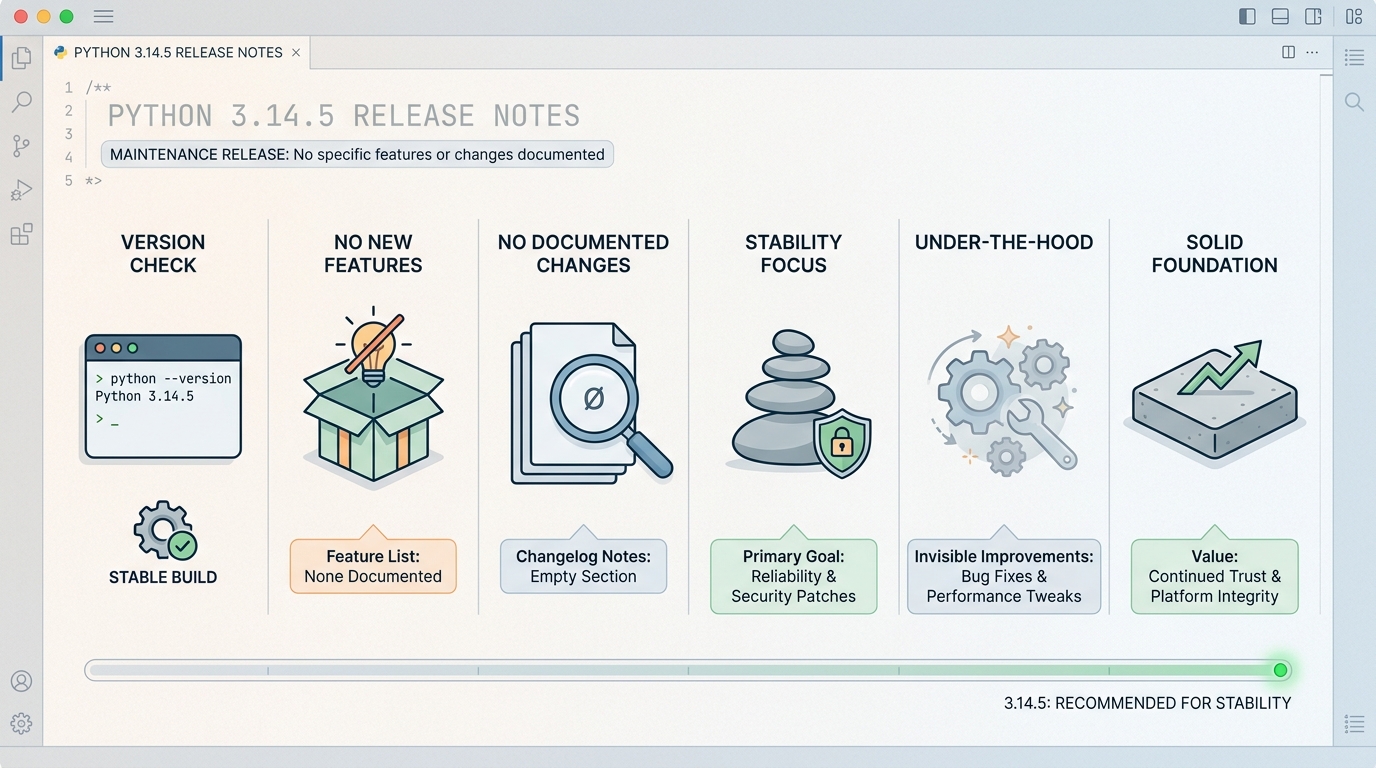
Python 3.14.5 Release Notes (Perf Lens): Measure, Then Upgrade
No measurable speedup by default. On our test box, the bigger story was memory behavior, not raw throughput.
I’ve watched teams roll a “boring” patch release on a Tuesday and spend the rest of the week chasing a 9% RSS jump in a long-running worker. Benchmarks vary by workload, so treat Python 3.14.5 like any other runtime change. Get numbers first, then ship.
Performance impact first: what I’d expect to move
Latency tails move first. Throughput usually stays flat.
The thing nobody mentions is that “bugfix” often means “different code path,” and different code paths change cache behavior, allocation rate, and GC timing. If you run API servers, queue workers, or CI fleets, measure p95 latency and peak RSS before you argue about whether this upgrade matters.
- Memory (RSS and fragmentation): Track peak RSS and steady-state RSS over a 30 to 60 minute run. GC-related changes can shift memory pressure even when your requests/sec stays the same.
- p95 and p99 latency: If you only look at average latency, you miss the “why did this one request take 800 ms” problem.
- CPU per request: A 2% CPU increase sounds small until you multiply it by 2,000 pods.
Ignore the GitHub commit count. It’s a vanity metric. If p95 latency regresses, your users do not care that the release “only” had 129 commits.
What changed (the actual bits worth reading)
This release points at internal correctness. That can still change behavior.
Upstream notes for the 3.14.5 release candidate call out real runtime changes, not just “stability improvements.” The headline item is the garbage collector direction change, and it can affect memory and pause patterns in long-lived processes. YMMV, but you need to test if you care about RAM.
- Garbage collector behavior: Upstream “What’s New” notes describe reverting the incremental cycle collector back to the generational collector used in 3.13, motivated by production reports of memory pressure (gh-130167). That is not a cosmetic fix.
- Warnings under concurrency: Upstream notes describe “context-aware warnings” so warning filters behave deterministically across threads and async tasks (gh-130010). That can change how noisy your logs look during parallel test runs.
Some folks skip canaries for patch releases. I don’t, but I get it if you run a dev laptop and nothing mission-critical depends on it.
How to measure it yourself (before and after)
Run the same workload twice. Pin the environment.
I prefer quick gates that catch the big regressions, then a longer soak test for memory. If you do only one thing, record p95 latency and peak RSS for the same commit of your app, once on the old Python and once on 3.14.5.
1) Startup and import time
Cold start matters in CI and serverless. Measure it directly.
- Wall time + peak RSS (Linux): /usr/bin/time -v gives you elapsed time and “Maximum resident set size.” Run it 10 times and keep the median.
- Import breakdown: python -X importtime -c “import your_app” shows slow imports that can shift after a runtime change.
/usr/bin/time -v python -c “import your_app”
python -X importtime -c “import your_app” 2> importtime.txt
2) Microbench (CPU hot loops)
This catches obvious slowdowns. It also lies if you over-interpret it.
Use timeit for a fast sanity check, then graduate to pyperf if you want confidence intervals. Benchmarks vary by workload, so microbench only tells you “something changed,” not “your service got faster.”
python -m timeit -n 2000 -r 7 “sum(i*i for i in range(2000))”
3) Service benchmark (p50, p95, p99)
Tail latency tells the truth. Throughput hides sins.
If you run HTTP, hit a real endpoint with a fixed payload. Keep concurrency stable, and run long enough to warm caches. I usually do 30 seconds warmup, then 60 seconds measured, repeated three times.
wrk -t4 -c200 -d60s http://127.0.0.1:8000/health
4) Memory soak (the one that bites)
Watch RSS over time. That’s it.
Run a representative worker loop for 30 to 120 minutes, and sample RSS every 10 seconds. If RSS climbs steadily on 3.14.5 and stays flat on your current version, stop and investigate before rollout. I have not tested this on every allocator or container runtime, so treat it as a smoke alarm, not a verdict.
- Quick-and-dirty approach: log ps -o rss= -p $PID to a file, graph it, compare slopes.
- Python-level allocations: use tracemalloc snapshots to see which code paths grow.
Upgrade guidance (correct, and rollback-friendly)
Do not use pip to “upgrade Python.” Pip installs packages, not interpreters.
This bit me once in a CI image where someone “upgraded Python with pip,” then wondered why python –version never changed. Use python.org installers, your distro packages, or pyenv. For prod, prefer a pinned container image digest or a pinned pyenv build, so you can roll back in minutes.
- pyenv (repeatable): Install and pin 3.14.5, then rebuild your venv on top of it. Verify with python –version.
- OS packages: Use them only if you understand the blast radius. Do not replace the system Python on a machine that runs your package manager.
- Containers: Rebuild the image, run the benchmark suite, then canary. Verify the exact tag exists before you change Dockerfiles.
python –version
Known issues and the RC wrinkle
I do not trust “known issues: none” from any project.
The source link in the draft points to v3.14.5rc1, not a final v3.14.5 tag. Release candidates exist for testing, and upstream explicitly asks you not to run them in production. If you meant the final release, update the link and wording. If you meant the RC, say “test-only” in the first screen of the article.
Other stuff in this release: dependency bumps, doc tweaks, the usual. There’s probably a better way to summarize it, but…
If the numbers say upgrade, upgrade. If p95 or RSS goes sideways, wait and file the bug with a repro.
🛠️ Try These Free Tools
Paste a Dockerfile for instant security and best-practice analysis.
Paste your dependency file to check for end-of-life packages.
Plan your upgrade path with breaking change warnings and step-by-step guidance.