open() started decoding bytes differently on one Windows runner. Python 3.15.0b1 is the early warning siren: UTF-8 goes default, imports get a new lazy keyword, and observability finally stops guessing your stack traces.UTF-8 mode becomes the default (PEP 686)
Everybody says their systems are UTF-8. Plenty of them are lying. Starting in 3.15, Python enables UTF-8 mode by default. That means text decoding defaults stop shadowing your host locale quirks. Good for consistency. Bad for any code path that implicitly relied on legacy encodings (think: Windows, vendor CSV dumps, old ETL jobs that never set encoding= because “it always worked”). PEP 686 is explicit about the intent: make encoding behavior predictable across platforms. ([peps.python.org](https://peps.python.org/pep-0686/?utm_source=openai))
So what? Expect previously “stable” tests to fail with UnicodeDecodeError or, worse, silent mojibake if you were doing lossy decode/encode dance. If you ship CLIs to customers, support tickets will spike unless you’ve been disciplined about encodings.
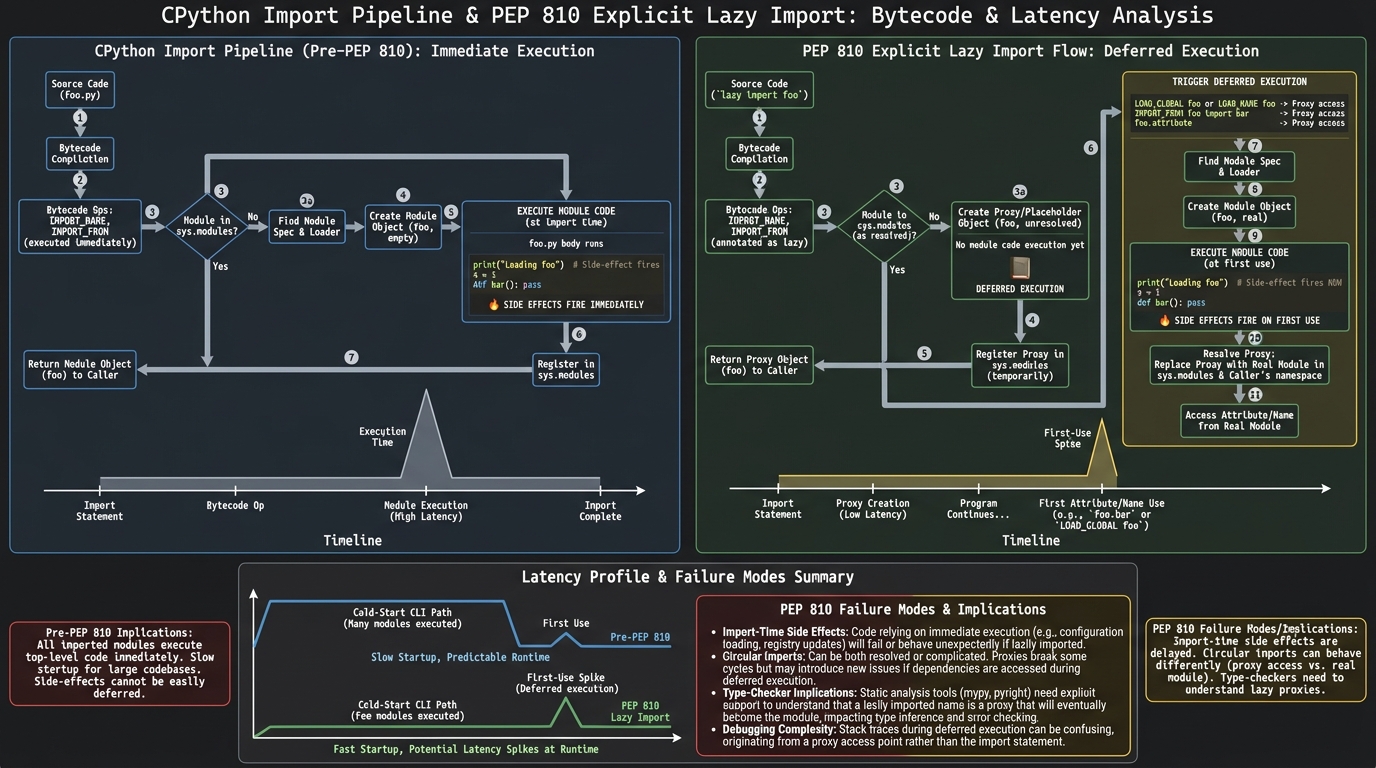
Explicit lazy imports (PEP 810): import latency isn’t free anymore, it’s deferred
PEP 810 adds lazy import X / lazy from X import Y. Under the hood, it’s not magic dust; it’s interpreter machinery that touches IMPORT_NAME, IMPORT_FROM, LOAD_GLOBAL, and LOAD_NAME to delay module execution until first use. ([peps.python.org](https://peps.python.org/pep-0810/?utm_source=openai))
So what? Startup-heavy workloads (CLIs, short-lived jobs, serverless handlers) can stop paying import tax up front. But the bill doesn’t disappear — it moves. The first request hitting a lazily imported code path now eats the import latency. If that path is on your p95, you just invented a new kind of tail latency. Also, import-time side effects (registry setup, monkeypatches, env var reads) become booby traps when they happen “later” than you expected.
abi3t + ABI checks: free-threading is forcing packaging to grow up (PEP 803 + gh-137210)
Free-threaded builds are no longer a science project, so the ecosystem needs wheels that don’t explode when the GIL semantics differ. Python 3.15 introduces abi3t via PEP 803, plus runtime/tooling hooks like Py_mod_abi and PyABIInfo_Check() (tracked in the 3.15 beta changelog as gh-137210). ([peps.python.org](https://peps.python.org/pep-0803/?utm_source=openai))
So what? If you ship native extensions, you don’t get to hand-wave ABI compatibility anymore. Expect build/publish pipelines to add checks, and expect users to discover that “abi3” isn’t a single bucket when free-threaded enters the chat.
Frame pointers by default (PEP 831): profiling stacks that aren’t fiction
PEP 831 pushes CPython builds toward keeping frame pointers so system profilers and eBPF tooling can unwind reliably. The PEP includes a concrete metric: for the same workload and sampling rate, 5.6MB perf data with frame-pointer unwinding vs 306.5MB with DWARF unwinding — 55x larger — for ~38k samples. ([peps.python.org](https://peps.python.org/pep-0831/?utm_source=openai))
So what? On-call engineers stop arguing whether the flame graph is “real.” You can profile production Python like you profile everything else. Caveat: frame pointers can shift register allocation and stack usage in hot C paths; measure before you brag.
Changelog removals that will break dusty corners
Beta 1 already includes removals and scheduled removals: gh-133604 removes platform.java_ver(); gh-132798 schedules legacy PyUnicode codec helpers for removal in 3.15. ([docs.python.org](https://docs.python.org/3.15/whatsnew/changelog.html?utm_source=openai))
So what? If you maintain bindings or vendored C code, you’re not “immune because Python minor versions don’t break things.” You’re just behind on paying down tech debt.
Python’s maintainers are paying off three kinds of architectural debt at once.
First: cross-platform correctness. PEP 686 is Python admitting that platform-default encodings are a chronic footgun and that “but Windows” has been an excuse for too long. ([peps.python.org](https://peps.python.org/pep-0686/?utm_source=openai))
Second: import-time bloat. Ecosystems got addicted to heavy module-level imports because it was the path of least resistance. Explicit lazy imports are the compromise that avoids the ecosystem-wide risk that sank implicit lazy importing attempts, while still letting teams claw back cold-start time. ([lwn.net](https://lwn.net/Articles/1041120/?utm_source=openai))
Third: operability. Frame pointers and the new standard profiling tooling are Python reacting to the reality that production debugging is done with perf, eBPF, and fleet-wide observability systems — not by sprinkling print() and praying. ([peps.python.org](https://peps.python.org/pep-0831/?utm_source=openai))
Don’t “upgrade.” Stage a compatibility burn-in. Beta means you run it in CI and in canaries, not on Friday night.
Install & run
# Using pyenv (example)
pyenv install 3.15.0b1
pyenv local 3.15.0b1
python -VV

# Virtualenv
python -m venv .venv
. .venv/bin/activate
python -m pip install -U pip setuptools wheel

# Run your suite
python -m pytest -q
Toggle UTF-8 mode to expose assumptions
# Force legacy behavior (control group)
PYTHONUTF8=0 python -m pytest

# Confirm default behavior (3.15 default)
unset PYTHONUTF8
python -m pytest
Try the new profiler on a real workload
python -m profiling.sampling run your_script.py
Red Flags (watch your logs)
- UnicodeDecodeError / UnicodeEncodeError in paths that previously “never failed” (usually means you were decoding garbage with a permissive legacy codec).
- New p95 latency spikes on first-hit endpoints after adopting lazy imports (import cost moved onto the request path).
- Wheel install failures or runtime crashes in C extensions after ABI checks — especially when experimenting with free-threaded builds.
- Profiling/observability regressions: broken symbolization, missing stacks, or tooling that assumes frame pointers are absent (yes, some wrappers do).
🛠️ Try These Free Tools
Plan your upgrade path with breaking change warnings and step-by-step guidance.
Paste a PEM certificate to check expiry and get a security grade.
Track These Releases