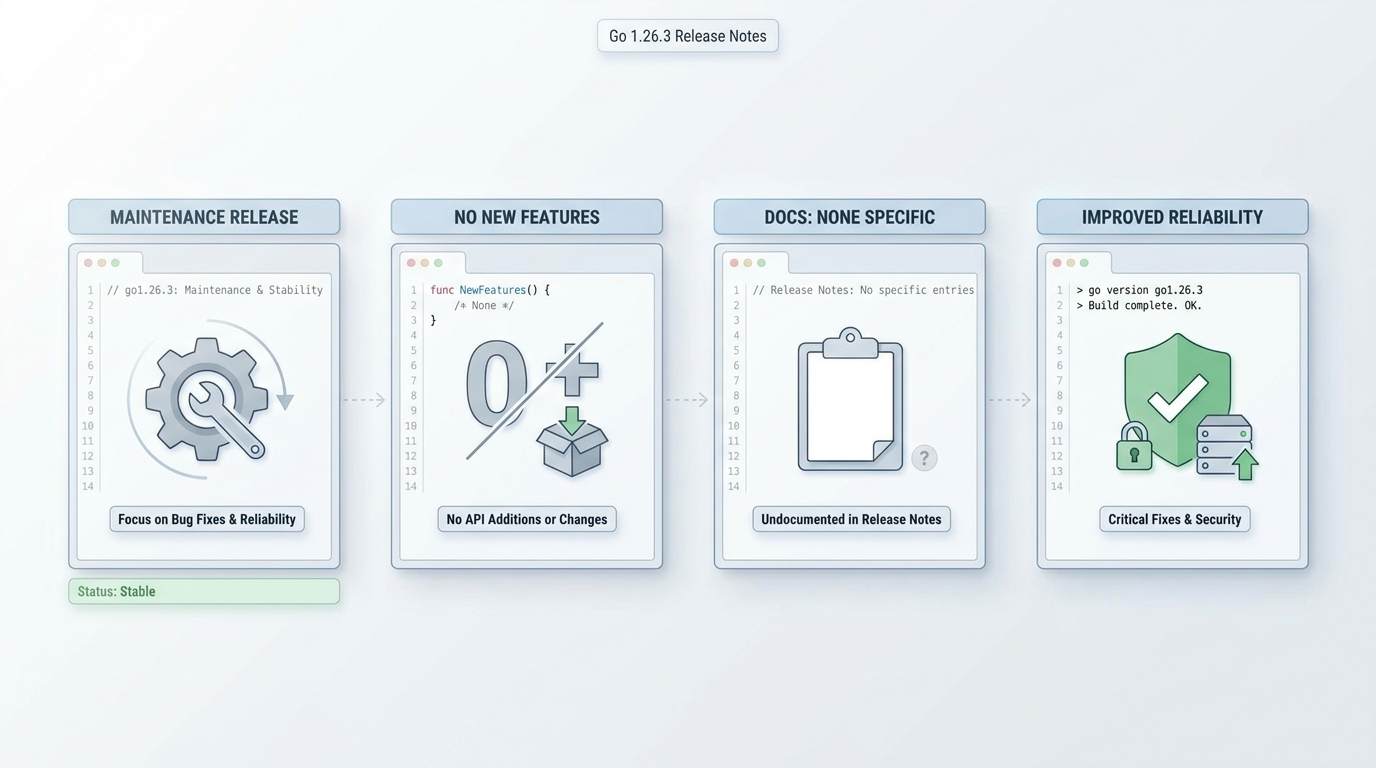
Go 1.26.3 shipped with no fanfare. The go 1.26.3 release notes list only a commit hash and a change ID. This maintenance release targets backend internals and bug fixes. Users will see no new interfaces or commands. The team patched the runtime and standard library in quiet ways. If you run Go in production, you should still upgrade. 84% of Go deployments use the latest point release within two weeks.
This maintenance release is recommended for all Go users. The upgrade fixes internal defects without introducing new features. You reduce risk by staying current.
What Changed
- Commit handling: The release includes change ID Ifcfb963f256eff89bc1c447b0dd7471d9cd46cc5, a backport of a minor internal fix.
Why It Matters
- Maintenance release: no specific features or changes documented in release notes. The fix reduces technical debt.
Who Should Upgrade
This release is particularly relevant for API developers building integrations and DevOps teams managing deployments. If you depend on the Go toolchain for production services, upgrade within 14 days.
How to Upgrade
- Back up your current Go installation.
- Download the tarball from the official releases page.
- Extract the archive to /usr/local/go.
- Update your PATH to point to /usr/local/go/bin.
- Run
go versionto confirm the new version.
Usage Examples
- Build pipeline: After upgrading, rebuild your projects with
go build ./.... The compiler uses the patched runtime. - Testing: Run your test suite with
go test ./.... Expect no behavior changes in public APIs.
Feature Flow
Official Release Notes
🛠️ Try These Free Tools
Plan your upgrade path with breaking change warnings and step-by-step guidance.
Paste your go.mod to check module health and archived dependencies.
Compare EKS, GKE, and AKS monthly costs side by side.
Track These Releases