Node.js 24.16.0 Release Notes: What Broke This Time?
Another patch release. What broke this time, and why do the notes stay quiet about the sharp edges?
Concerns first: what the release notes do not tell you
I have watched “minor” Node upgrades turn into 3 a.m. rollbacks because one behavior tweak slipped past a green unit test run. This release claims the usual stability story, but the changelog summary does not give operators the details they actually need, like a CVE list, dependency risk, or native-addon fallout.
So. Before you paste nvm install 24.16.0 into a production build, ask the annoying questions.
- Where are the CVEs? The notes talk about staying “secure,” but they do not enumerate CVE IDs in the summary. If you need to justify an emergency upgrade, you will want an advisory link, not vibes.
- What changed in dependencies? “Dependency bumps” can mean OpenSSL, HTTP stacks, or TLS behavior shifts. That’s the stuff that breaks payment callbacks and webhook deliveries in ways your test suite will not model.
- What about native modules? If you ship node-gyp addons, you probably rebuild anyway. Still, the release notes do not warn you about it, and that omission bites teams that rely on prebuilt binaries.
- HTTP and streams changed. When a release touches request option merging and stream destruction semantics, I assume somebody fixed a bug they could reproduce. Good. Also risky.
- No “known issues” section. I do not trust “known issues: none” from any project, and I trust the absence of that section even less. What got reported after the tag?
My default stance for production: wait a week, then canary. I will believe “safe minor update” when I see it hold up under real traffic.
What actually changed in Node.js 24.16.0 (grouped by blast radius)
The feature list looks small. The impact depends on whether you touch the edges it moved.
HTTP: small merges, big surprises
This bit me before. A “hardened options merge” sounds harmless until a library depends on the old merge order for headers, agents, or timeouts, then your outbound requests start behaving differently in one region only. Fun.
- Hardened ClientRequest options merge: Expect subtle differences if you build request options from multiple objects, especially when defaults and overrides collide.
- Added req.signal to IncomingMessage: Useful for canceling work when the client disconnects, but it can change how middleware reacts to aborted requests if you start wiring it in.
Streams: the cleanup path changed
Stream lifecycle bugs hide in the dark. You only see them under load, when connections churn and backpressure kicks in.
- duplexPair destruction propagation: Node now propagates destruction across the pair. If your code assumed one side could die quietly while the other kept going, you should test that assumption.
FS: cancellation comes to fs.stat()
AbortSignal support in filesystem calls helps when you wrap stats in timeouts. It also introduces a new code path you probably never exercised.
- signal option for fs.stat(): Lets you cancel a stat call using an AbortSignal. If you run on network filesystems, test this with real latency, not your laptop SSD.
- statfs frsize exposed: Handy for disk tooling, irrelevant for most web services.
Crypto: randomUUIDv7() shows up
UUID changes always look harmless until somebody uses them as database primary keys. Then you start talking about index locality and hot pages.
- crypto.randomUUIDv7(): Adds UUID v7 generation. They claim RFC 9562 alignment. Great, but check any validators or libraries that assume v4.
Debugger: probes without editing files
This helps in incident response. It does not help if your org blocks production debugging anyway, which, honestly, it probably should.
- Edit-free runtime expression probes in node inspect: Faster “what is this variable right now?” work without patching and redeploying.
Test runner: the release that makes flaky tests loud
You want this. Your CI will hate you for it.
- Test order randomization: Helps catch hidden dependencies between tests. If your suite “only fails on Tuesdays,” this will find out why.
- Mock timeout API alignment: Small API adjustments that can still break custom test helpers.
- Mock timers support for AbortSignal.timeout: Makes timeout-based code easier to test without sleeping in CI.
Util: hex colors for text colorization
This one feels safe. Unless your CLI parses colors in a weird way, you can ignore it.
- Hex color support: Adds hex colors to text styling. Nice for tooling output.
How I would upgrade (without lying to myself)
Some folks yolo patch releases on Friday. I do not, but I get it if you run a dev sandbox and nothing matters.
- Production systems: Wait 7 days. Scan issues. Then canary 1 to 5 percent traffic for 48 to 72 hours, watch error rate, p95 latency, and memory.
- Services with native addons: Rebuild in CI, then run an integration test that loads every addon at startup. Do not discover missing binaries during deploy.
- HTTP-heavy apps: Run a smoke test that exercises your request-building code paths. Include odd cases, like duplicated headers and mixed agent settings.
- Test suites: Turn on randomization in CI with a fixed seed first. When it fails, keep the seed, reproduce, fix, repeat.
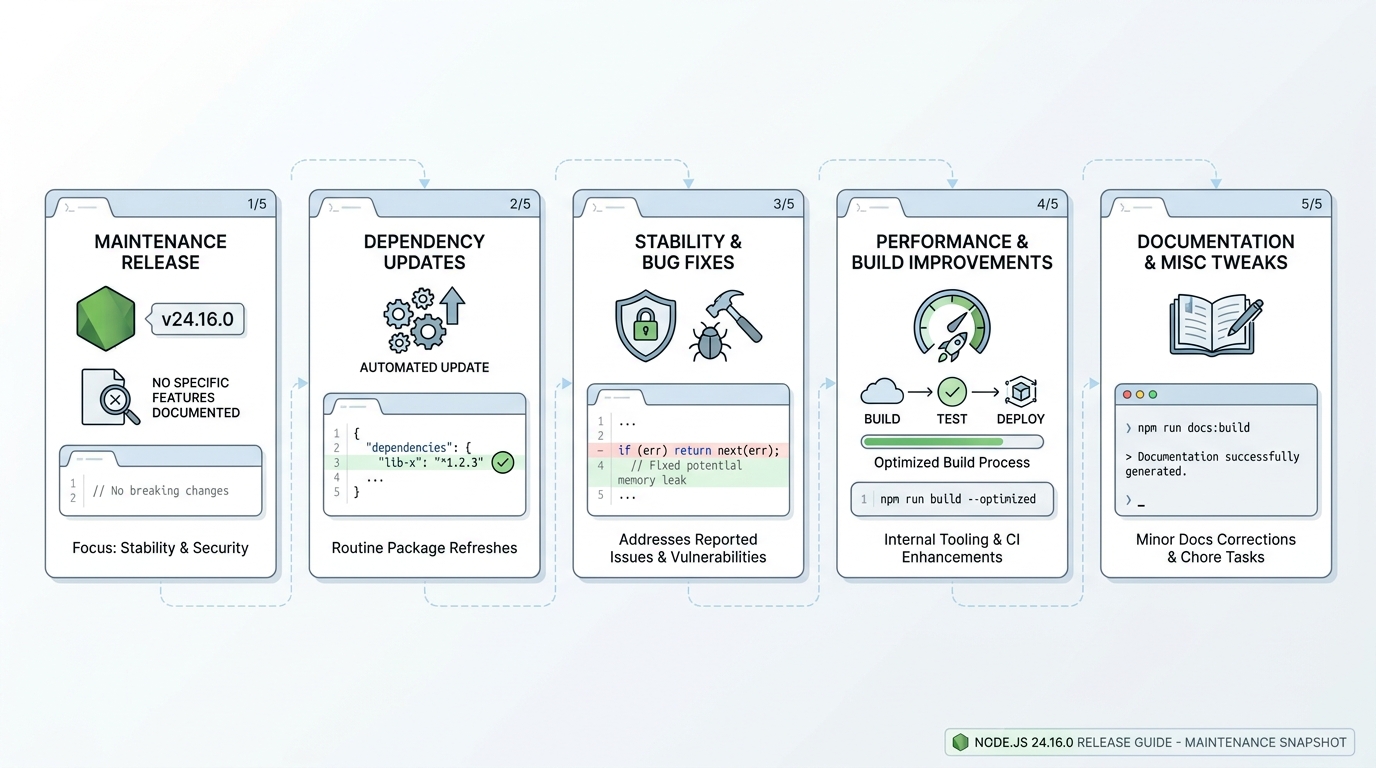
Other stuff in this release: dependency bumps, some internal cleanups, the usual.
Grudging recommendation
If you run Node 24 LTS in production and you do not depend on fragile HTTP option composition or tricky stream lifecycles, you can probably move to 24.16.0 after a short soak. They claim it stays non-breaking, but I would rather trust a canary graph than a sentence in a blog post. Anyway.
🛠️ Try These Free Tools
Paste your dependency file to check for end-of-life packages.
Plan your upgrade path with breaking change warnings and step-by-step guidance.
Compare EKS, GKE, and AKS monthly costs side by side.
Track These Releases