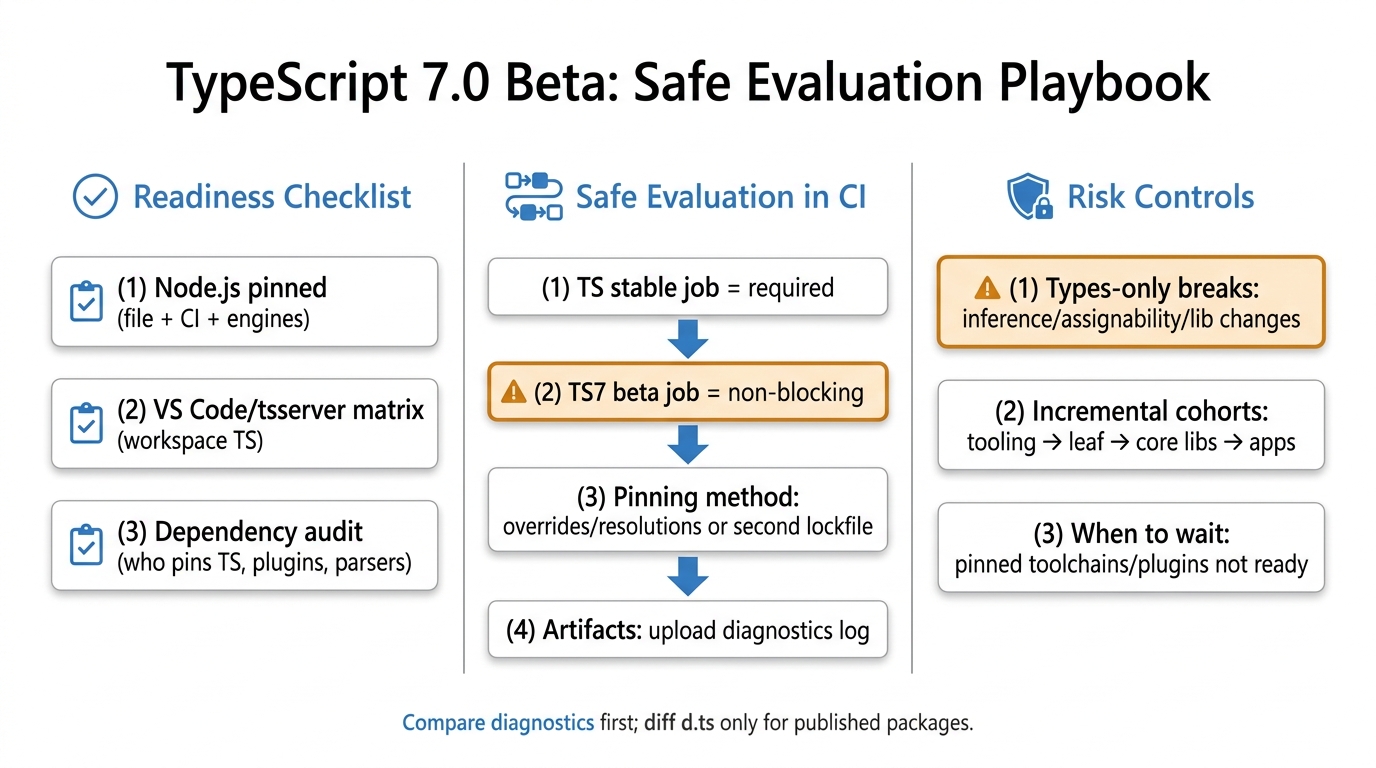
TypeScript major betas are where you find the real breakpoints: types-only changes that still fail builds, editor/tsserver mismatches that burn time, and CI noise from slightly different emit or d.ts shapes.
This is an operator’s playbook for evaluating the TypeScript 7.0 beta without destabilizing production: a readiness checklist (Node + editor + dependency audit), a safe dual-build CI strategy with deterministic pinning, and migration risk controls that keep diffs actionable.
Contents
- What’s actually changing in TypeScript 7.0 (from an operations perspective)
- Readiness checklist: Node version, tsserver/VSCode matrix, dependency audit
- Safe evaluation: pinning, dual-build CI, and diff triage
- Migration risk controls: types-only break patterns, incremental adoption, and when to wait
- Migration path: a practical rollout plan for monorepos
What’s actually changing in TypeScript 7.0 (from an operations perspective)
For a major TS bump, the “what changed?” question matters less than “what will cause CI diffs and editor churn?” In practice, TypeScript major betas tend to land in four buckets:
- Checker behavior changes (new errors, fewer errors, different inference). These are “types-only” but still break builds because you typecheck in CI.
- Declaration emit changes (different
.d.tsshape). These cause downstream package diffs and churn in generated types used by consumers. - Compiler performance/parallelism changes that can impact build orchestration and caching assumptions.
- Tooling version matrix changes:
tsserver, VS Code’s bundled TypeScript, and language service plugins.
For TS 7.0 specifically, the safe stance is: assume you will see at least some new type errors plus minor d.ts/emit diffs, and plan your beta evaluation around isolating those diffs. Don’t treat a beta like a normal dependency bump; treat it like a controlled experiment.
Where to track the official truth
Use the official TypeScript sources for authoritative details and breaking-change notes:
- TypeScript blog and release notes: https://devblogs.microsoft.com/typescript/
- TypeScript GitHub releases (beta/rc tags): https://github.com/microsoft/TypeScript/releases
- Breaking changes doc (kept up to date during prerelease cycles): https://github.com/microsoft/TypeScript/wiki/Breaking-Changes
ReleaseRun coverage worth reading alongside this playbook:
- TypeScript 7.0 beta platform/version preview
- TypeScript 7.0 beta native compiler parallelism
- TypeScript 7.0 beta faster builds vs migration tax
- TypeScript 6.0 upgrade guide (production)
- Speed up TypeScript builds (TS 5.7/5.8 performance playbook)
What “success” looks like for a beta evaluation
Define success criteria up front. A TS 7 beta evaluation is useful if you can answer these with evidence:
- Do we get new errors? If yes, are they real bugs, or checker strictness shifts we can suppress without hiding signal?
- Do we get
.d.ts/.jsdiffs? If yes, are they stable and explainable, or nondeterministic? - Does build time improve or regress on our real repo in CI (not a microbenchmark)?
- Do editors behave: no tsserver crashes, no plugin incompatibility, no “works on my VS Code” mismatches?
Readiness checklist: Node version, tsserver/VSCode matrix, dependency audit
Before you run TS 7 beta anywhere near CI, make the environment deterministic. Most “TypeScript upgrade problems” are actually toolchain drift.
1) Node.js + package manager compatibility
Pin your Node version in three places: local dev, CI, and any build images. For monorepos, the fastest way to reduce churn is a single authoritative pin:
.nvmrcor.node-versionengines.nodein the rootpackage.json- CI config (e.g.,
actions/setup-node, Buildkite plugin, CircleCI orb)
{
  "engines": {
    "node": ">=20.0.0"
  },
  "packageManager": "pnpm@9.0.0"
}
Operational rule: don’t evaluate a TS beta during a Node major transition. If you need Node upgrades anyway, do that first, stabilize, then evaluate TS 7.
2) tsserver/VS Code version matrix (avoid editor-driven false negatives)
Two common failure modes:
- CI uses TS 7 beta but developers’ editors still use VS Code’s bundled TypeScript (often stable), so local diagnostics don’t match CI.
- Developers opt into TS 7 beta in VS Code, but CI stays on stable—so PRs get surprise failures.
Control this with a simple policy and a documented matrix:
| Context | TypeScript version source | Pin strategy | Expected behavior |
|---|---|---|---|
| CI typecheck | Repo dependency | devDependency: typescript pinned |
Authoritative gate |
| VS Code diagnostics | Workspace TS | Use “Select TypeScript Version” → workspace | Matches CI |
| tsserver plugins | Workspace node_modules | Pin plugin versions; test against TS 7 beta | No crashes / no missing features |
Make it explicit in CONTRIBUTING:
## VS Code TypeScript

This repo pins TypeScript via package.json. In VS Code:
1) Cmd/Ctrl+Shift+P
2) “TypeScript: Select TypeScript Version”
3) Choose “Use Workspace Version”
If your org uses JetBrains, Neovim LSP, or other editors, apply the same rule: make the repo’s node_modules/typescript the source of truth wherever possible.
3) Dependency audit strategy (find the real blockers)
TypeScript itself is rarely the blocker. The blockers are:
- framework tooling that pins TS (or assumes specific compiler internals)
- tsserver/language-service plugins
- codegen tools that parse TS AST (ts-morph, custom transformers, eslint parsers)
- type utilities that rely on edge inference behavior
Run two audits:
- Who depends on TypeScript? (directly or transitively)
- Who pins TypeScript? (peerDependencies/devDependencies constraints)
Commands (pick your package manager):
# pnpm
pnpm why typescript
pnpm -r list typescript

# yarn classic/berry
yarn why typescript

# npm
npm ls typescript
Then search for peer dependency ranges that may reject a beta:
# quick scan for peer dependency constraints
rg "peerDependencies" -n package.json
rg "typescript" -n package.json
Operational rule: if your stack relies on tools that hard-pin TS (or break on prereleases), you either (a) isolate TS 7 beta to a subset of packages or (b) wait. Don’t “force install” your way into an un-debuggable toolchain.
Safe evaluation: pinning, dual-build CI, and diff triage
The goal is to evaluate TS 7 beta without changing production outputs by default. That means (1) deterministic pinning, (2) running TS stable and TS 7 beta side-by-side, and (3) routing diffs into a triage workflow instead of letting them flood PRs.
1) Pin TypeScript 7 beta without infecting the whole repo
There are three workable patterns. Pick one and standardize it.
Pattern A: Separate CI job installs TS 7 beta as a one-off
This keeps the repo on stable while CI runs an extra job using TS 7 beta.
# Example: install TS beta for the job only (pnpm)
# Assumes lockfile stays on stable.
pnpm add -Dw typescript@beta
pnpm -w tsc -v
pnpm -w -r run typecheck
Downside: it mutates the workspace unless you do it in an ephemeral checkout and never commit the lockfile changes.
Pattern B: Use package manager overrides/resolutions for a dedicated “beta” install mode
This is cleaner for monorepos: keep stable in package.json, and have a CI-only override that forces TypeScript to beta.
pnpm (pnpm.overrides):
{
  "devDependencies": {
    "typescript": "^6.0.0"
  },
  "pnpm": {
    "overrides": {
      "typescript": "7.0.0-beta.0"
    }
  }
}
Yarn (resolutions):
{
  "devDependencies": {
    "typescript": "^6.0.0"
  },
  "resolutions": {
    "typescript": "7.0.0-beta.0"
  }
}
Operational detail: don’t commit that override to main unless you want everyone to be on beta. Instead, inject it during CI (see below).
Pattern C: Two lockfiles (stable + beta) for fully deterministic dual builds
Most deterministic, most maintenance. You keep:
pnpm-lock.yaml(stable)pnpm-lock.ts7.yaml(beta)
In CI, choose which lockfile to use before install. This avoids resolution churn and makes diffs explainable.
2) Dual-build CI: stable gate + beta signal
Run two separate jobs:
- TS stable: required, blocks merge.
- TS 7 beta: non-blocking at first, produces a report artifact and a trend line.
GitHub Actions sketch (adapt to your CI):
name: typecheck
on: [pull_request]

jobs:
  typecheck-stable:
    runs-on: ubuntu-latest
    steps:
      - uses: actions/checkout@v4
      - uses: actions/setup-node@v4
        with:
          node-version-file: .nvmrc
          cache: 'pnpm'
      - run: corepack enable
      - run: pnpm install --frozen-lockfile
      - run: pnpm -r run typecheck

  typecheck-ts7-beta:
    runs-on: ubuntu-latest
    continue-on-error: true
    steps:
      - uses: actions/checkout@v4
      - uses: actions/setup-node@v4
        with:
          node-version-file: .nvmrc
          cache: 'pnpm'
      - run: corepack enable
      - name: Inject TS7 override (CI only)
        run: |
          node -e "const fs=require('fs');const p=JSON.parse(fs.readFileSync('package.json','utf8'));p.pnpm=p.pnpm||{};p.pnpm.overrides={...(p.pnpm.overrides||{}),typescript:'7.0.0-beta.0'};fs.writeFileSync('package.json',JSON.stringify(p,null,2));"
      - run: pnpm install --no-frozen-lockfile
      - run: pnpm -r run typecheck 2>&1 | tee ts7-beta-typecheck.log
      - uses: actions/upload-artifact@v4
        with:
          name: ts7-beta-typecheck
          path: ts7-beta-typecheck.log
Notes:
- The beta job intentionally uses
--no-frozen-lockfilebecause you’re injecting overrides. If you need full determinism, use the two-lockfile pattern instead. - Keep the beta job non-blocking until you’ve triaged the first wave of errors and established a suppression strategy.
3) Avoid CI diffs: control your outputs and isolate what you compare
CI diffs come from comparing artifacts that shouldn’t be compared in a beta evaluation. If your pipeline produces build artifacts (compiled JS, .d.ts, sourcemaps), don’t immediately diff the whole repo output. Diff only what you need to learn:
| Artifact | Diff risk | What to do in beta |
|---|---|---|
tsc --noEmit diagnostics |
Low noise, high signal | Primary comparison (stable vs beta) |
.d.ts output |
Medium/high noise | Diff only for published packages; store as artifact |
| JS emit | Usually low (unless new emit behavior) | Don’t diff unless you ship compiled output |
| sourcemaps | High noise | Exclude from diffing |
A practical diff strategy for monorepos is: run --noEmit everywhere, and only run --emitDeclarationOnly for packages that publish types.
# typecheck everything
pnpm -r run typecheck

# for publishable packages only
pnpm -r --filter "./packages/*" run build:types
4) Diff triage patterns that keep the signal
When TS 7 beta reports failures, you want them grouped into buckets that map to action:
- Real bug found: TS 7 exposed unsoundness; fix the code.
- Inference/regression: minimize, file upstream issue, add a local workaround.
- Library type mismatch: fix/upgrade
@types/*or the library; sometimes pin types. - Tooling mismatch: eslint parser, ts-jest, ts-node, tsx, vite plugin; resolve tool versions before touching app code.
Make it mechanical. Capture diagnostics in a stable format:
# JSON diagnostics make it easier to diff
pnpm -w tsc -p tsconfig.json --noEmit --pretty false --extendedDiagnostics false
For deeper automation, consider --generateTrace when investigating performance regressions (checker hot paths) and keep traces as artifacts. Official docs: TypeScript Performance.
Migration risk controls: types-only break patterns, incremental adoption, and when to wait
TypeScript major upgrades usually don’t break runtime behavior; they break assumptions. The trick is keeping the blast radius small while you learn which assumptions your codebase relies on.
Types-only breaking change patterns to expect (and how to defuse them)
These show up in every major cycle. Treat them as recurring incidents with known mitigations.
1) Narrowing/inference changes around generics
Symptom: code that used to infer a permissive type now infers a narrower one (or vice versa), producing new errors at call sites.
Controls:
- Add explicit generic parameters at the call site for critical APIs.
- Add “type boundaries” around complex inference: helper types, overloads, or wrapper functions.
- Prefer explicit return types on exported functions in libraries to stabilize
.d.tsoutput.
// Stabilize emitted types for consumers
export function makeCache<K extends string, V>(): Map<K, V> {
  return new Map<K, V>();
}
2) Changes in assignability (especially unions/intersections)
Symptom: a value of type A | B no longer assigns to a target that “used to work”, or an intersection becomes stricter.
Controls:
- Introduce explicit discriminants for unions used across module boundaries.
- Avoid relying on structural overlap between unrelated types; create a shared interface.
- Use
satisfies(TS 4.9+) to keep literal types while validating shape—this reduces inference surprises.
type Config = {
  mode: 'dev' | 'prod';
  retries: number;
};

const config = {
  mode: 'prod',
  retries: 3,
} satisfies Config;
3) Declaration emit diffs (public surface area churn)
Symptom: .d.ts changes for exported symbols even if runtime code didn’t change. This is where “CI diffs” become time sinks for library repos.
Controls:
- Enforce explicit types for exported values (functions, objects, classes) to reduce re-inference.
- Use
stripInternaland/** @internal */where appropriate to keep internal types out of public d.ts. - Run an API surface diff tool for published packages (API Extractor is common) and treat changes as intentional.
4) Lib type changes (DOM, ES, Node) causing cascading failures
Symptom: errors appear in otherwise stable code due to updated lib definitions.
Controls:
- Pin
@types/node(and avoid “floating latest” during TS beta evaluation). - Make
tsconfig.jsonexplicit aboutlibinstead of relying on defaults if you ship libraries.
{
  "compilerOptions": {
    "target": "ES2022",
    "lib": ["ES2022", "DOM"],
    "types": ["node"]
  }
}
Incremental adoption in packages (monorepo strategy)
If you have a monorepo, don’t flip everything to TS 7 beta at once. Use a “package cohort” approach:
- Cohort 0: tooling-only packages (eslint configs, tsconfig packages). Validate that the toolchain installs and typechecks.
- Cohort 1: leaf packages with few dependents. Fix errors and measure build impact.
- Cohort 2: core shared libraries. Stabilize declaration emit and API diffs.
- Cohort 3: apps. Only after libraries are stable.
Make the cohort explicit in CI filters:
# Example: only typecheck a cohort under TS7 beta
pnpm -r --filter "./packages/tooling/**" run typecheck
pnpm -r --filter "./packages/leaf-*/**" run typecheck
When to wait (pragmatic guidance)
Wait for RC or stable if any of these are true:
- Your build relies on a framework toolchain that tightly couples to TypeScript versions and you can’t upgrade it independently.
- Your repo uses AST transforms, custom TypeScript patches, or language service plugins that haven’t been validated against TS 7 prereleases.
- You can’t afford churn in generated
.d.tsoutput for published packages during the evaluation window.
Still run the beta CI job even if you “wait.” The value is early warning and a backlog of fixes you can land gradually on stable TS.
Migration path: a practical rollout plan for monorepos
This rollout plan assumes you want signal early, without destabilizing the mainline.
Step 1: Stabilize the baseline
- Ensure TS stable typecheck is clean (or at least errors are intentional and tracked).
- Pin Node, package manager, and
@types/node. - Turn on deterministic compiler options where possible (
skipLibCheckis a trade-off; don’t change it during beta eval).
Step 2: Add the TS 7 beta CI job (non-blocking)
- Use overrides/resolutions or a second lockfile.
- Upload diagnostics as artifacts.
- Track the error count trend over time (even a simple grep-based metric is enough).
# crude but effective metric
pnpm -r run typecheck 2>&1 | tee ts7.log
node -e "const fs=require('fs');const s=fs.readFileSync('ts7.log','utf8');console.log('TS7 errors:',(s.match(/error TSd+:/g)||[]).length);"
Step 3: Triage and classify failures
Open issues in three buckets:
- Fix in code (real bugs, missing annotations, unsafe patterns)
- Fix in dependencies (upgrade/pin types, align tooling)
- Upstream TS issue (minimal repro, link to TS issue)
Step 4: Land “beta-safe” fixes on stable TypeScript
Many fixes are valid regardless of TS version: explicit exported types, cleaner discriminated unions, removing reliance on inference quirks. Land those on stable to reduce the eventual cutover diff.
Step 5: Cut over per cohort
When the beta job is consistently green (or down to a known small set of upstream issues), flip one cohort at a time to TS 7 (beta → rc → stable). Avoid “big bang” upgrades.
Step 6: Lock down editor consistency
Once you decide to adopt TS 7, make workspace TypeScript the default in docs and devcontainer configs. The easiest way to waste a week is having half the team on bundled TS and half on workspace TS.
Bottom Line
Use the TypeScript 7.0 beta as a controlled signal generator: keep stable TS as the merge gate, run TS 7 beta in parallel, and constrain diffs to diagnostics and intentional API surface checks. If your toolchain pins TypeScript tightly, don’t fight it—scope the evaluation to packages you control and wait for RC/stable for the rest.
🛠️ Try These Free Tools
Paste your dependency file to check for end-of-life packages.
Plan your upgrade path with breaking change warnings and step-by-step guidance.
Paste your workflow YAML to audit action versions and pinning.
Track These Releases